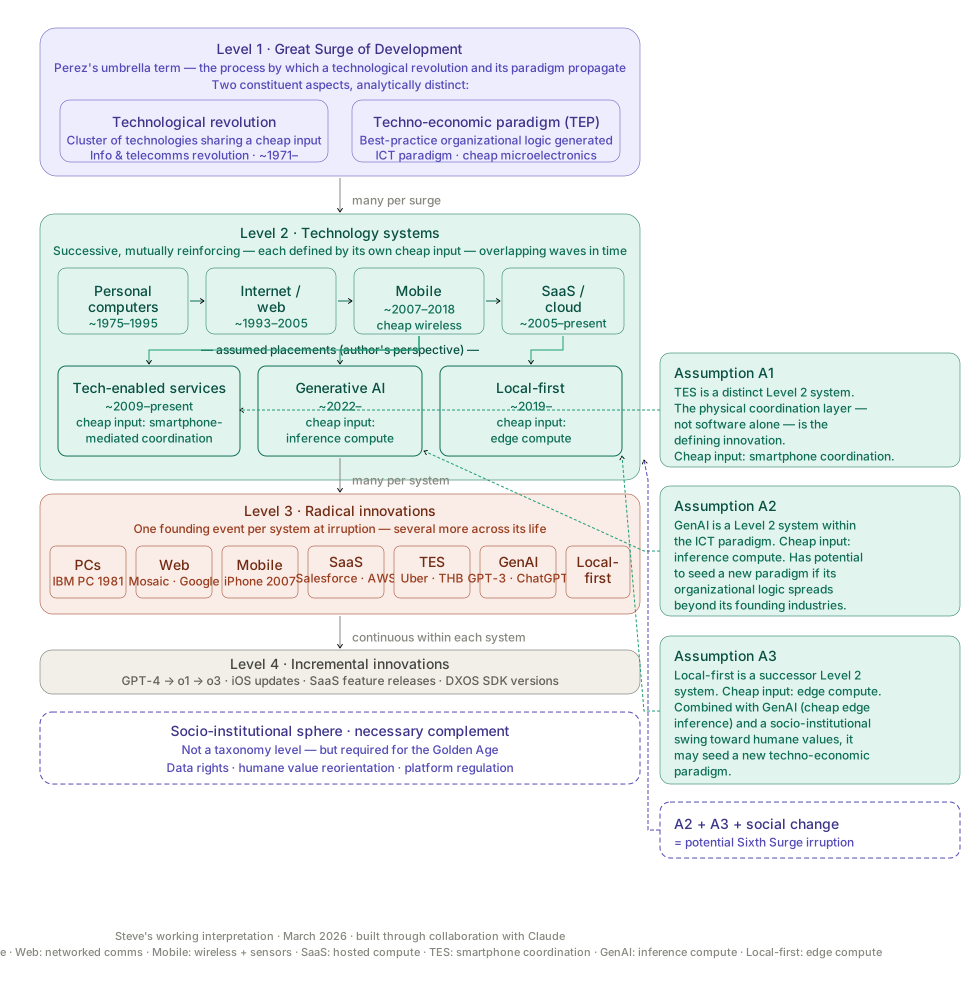
 Visualization based on Steve’s interpretation of Perez’s framework. See caveats below.
Every major technology transition generates the same claim from inside it: this one is different. This one is unprecedented. The speed, the scope, the lack of a roadmap — all of it points to something genuinely new.
The claim is usually wrong about the transition. It is usually right about the experience.
Carlota Perez is an economic historian who spent thirty years mapping how technological change actually moves through economies. What follows is my application of her framework — a lens I’ve been using to make sense of how these changes have unfolded over time, and why the current transition looks the way it does. This is not a summary of her views; where I extend her concepts beyond the scope of her original work, those extensions are my own.
The core observation: major technologies don’t arrive all at once. They arrive in waves — clusters of interrelated innovations that Perez calls technology systems. Each system has a cheap input (the cost that falls and drives adoption), a new organizational logic, and a life cycle: irruption, growth, maturity. Multiple systems exist within a single long wave of development — the current one, which Perez dates from the Intel microprocessor in 1971, has already produced five. Perez calls this the Information and Communications Technology (ICT) paradigm: the overarching organizational logic of the information age, built around cheap microelectronics, networked scale, and software-defined value.
| Technology system | Approximate period | Cheap input |
|---|---|---|
| Personal computers | ~1975–1995 | Cheap desktop compute |
| Internet and web | ~1993–2005 | Cheap networked communications |
| Mobile | ~2007–2018 | Cheap wireless and sensors |
| SaaS and cloud | ~2005–present | Cheap hosted compute on demand |
| Tech-enabled services | ~2009–present | Cheap smartphone-mediated coordination |
| Generative AI | ~2022–present | Cheap inference compute |
The cost of generating a model output has fallen faster than almost any comparable cost curve in computing history. That cost fall is what is driving adoption, reshaping product expectations, and putting pressure on companies that were correctly fit for the SaaS and cloud system.
The pattern each transition follows is this: companies that were correctly fit for the previous system find themselves in a specific structural condition as the next one takes hold. The metrics still look reasonable. The team is still shipping. The product still works. And yet — the ground has shifted. What customers can get from a next-generation product has changed. What they now expect has changed. The company is post-PMF in the old system and pre-PMF in the new one, simultaneously.
This happened to companies built for desktop when the web ascended. It happened again to companies built for the web when mobile ascended. It happened again to companies built for on-premise and installed software when SaaS and cloud ascended. Each time, the companies inside the transition thought it was unprecedented. Each time, the structural condition was recognizable.
What changes when you have the pattern isn’t the urgency — the window is real, and transitions have clocks. What changes is the move: from reacting to something that feels like a crisis to navigating something that has a shape.
A few caveats worth stating. Perez’s framework was developed in retrospect — she identified the five Great Surges of Development after they had largely run their course. The table above reflects two working assumptions I hold, not settled conclusions from her work.
Tech-enabled services as a distinct technology system. The table treats companies like Uber, Airbnb, and The Helper Bees as instances of a distinct technology system rather than a downstream effect of mobile or SaaS. The argument: the cheap input is genuinely distinct — cheap smartphone-mediated coordination of physical labor and assets — and the organizational logic (platform economics governing physical supply chains) is a meaningful departure from pure SaaS. The alternative reading is that Tech-Enabled Services is simply SaaS logic deploying into previously unreformed industries. I hold the first position, though the second is defensible.
Generative AI as a technology system within the current surge, not the beginning of the next one. The table places GenAI as the sixth technology system within the existing ICT paradigm rather than the irruption of an entirely new paradigm. The argument for it: cheap inference compute is a cost-curve event within the broader microelectronics paradigm; the organizational logic extends the ICT paradigm rather than replacing it. The argument against it: the speed and breadth of GenAI’s diffusion is already paradigm-scale, and the organizational logic it implies — every workflow rebuilt around learned models rather than coded rules — may be genuinely discontinuous. I hold the first position, with a conditional trajectory toward the second as conditions develop. A new paradigm may follow. That is a different transition, and a different problem.
The framework doesn’t tell you what to build. It tells you where you are, and what the condition you’re navigating looks like when it has been navigated successfully.
Carlota Perez, Technological Revolutions and Financial Capital (2002); “Technological Revolutions, Paradigm Shifts and Socio-Institutional Change” (2004); “Technological revolutions and techno-economic paradigms” (2009).